


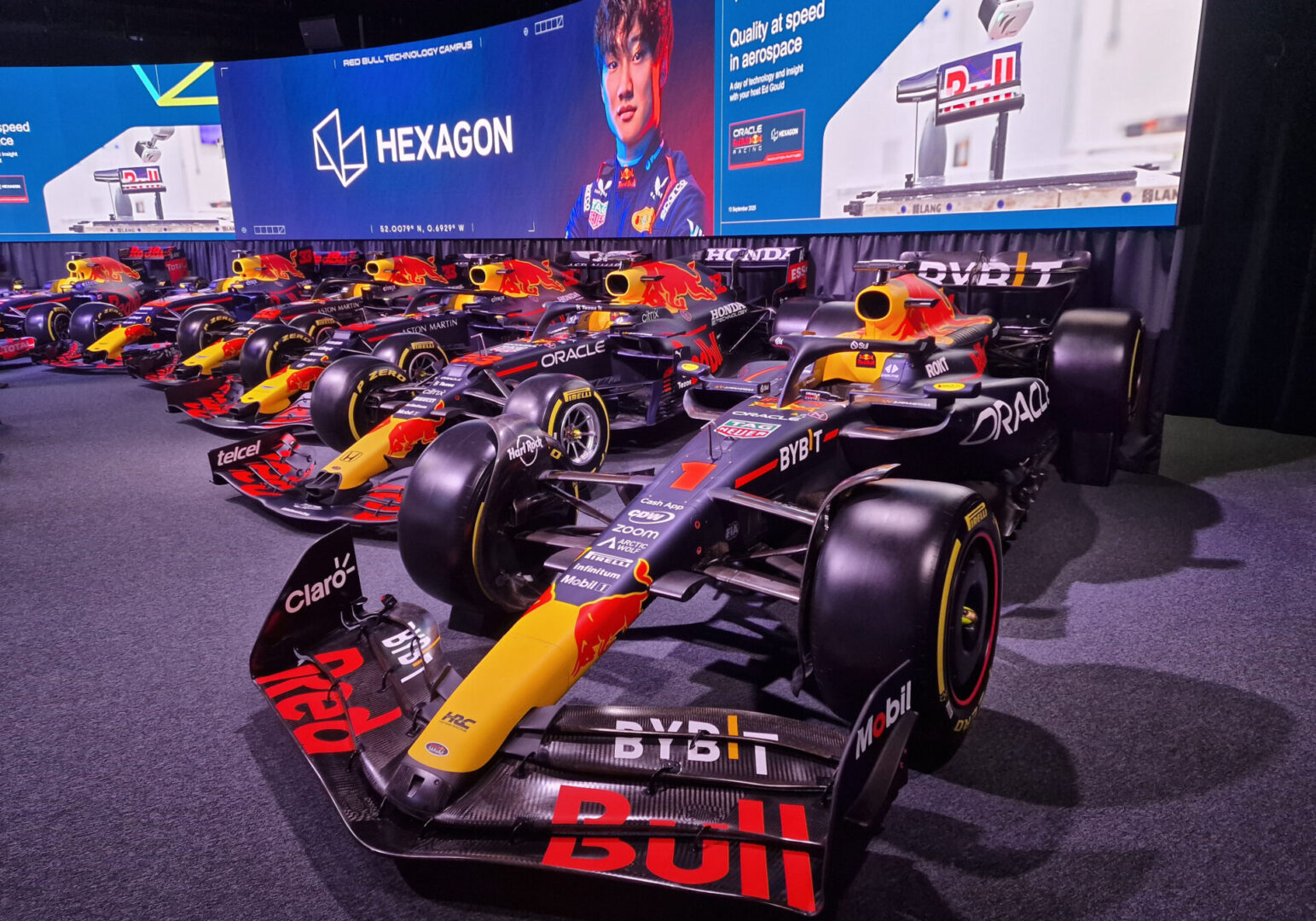
Aircraft manufacturers battling record order backlogs may find help from an unlikely source: Formula One.
Hexagon, a global leader in digital reality and metrology solutions, is transferring knowledge gained from its partnership with Oracle Red Bull Racing into the aerospace sector. The company believes that advanced measurement technologies, honed in the high-pressure environment of motorsport, could help streamline aircraft production, improve quality and ultimately reduce delivery delays.
The aerospace backlog now exceeds 15,000 commercial aircraft worldwide. With airlines demanding more fuel-efficient fleets to cope with rising passenger demand, Airbus and Boeing are under intense pressure to raise output. But delays in supply chains, shortages of skilled labour and the sheer complexity of aircraft assembly continue to slow progress.
Metrology at the heart of manufacturing
While Hexagon’s work with Red Bull Racing spans design, simulation and digital integration, it is in the field of metrology that the company sees the greatest opportunity for aerospace.
Metrology, the science of measurement, underpins every aspect of modern manufacturing. In F1, components are designed to tolerances measured in microns, and the accuracy of each part can determine the outcome of a race. Hexagon provides the scanning and inspection tools that verify whether a suspension arm, a body panel or an aerodynamic surface is manufactured exactly as intended.
This culture of measurement-first manufacturing is already second nature in motorsport, where precision and speed must coexist. By embedding similar systems in aerospace production lines, Hexagon argues that manufacturers can dramatically increase first-time quality rates. That, in turn, reduces the costly rework and part rejection that frequently causes bottlenecks in aircraft assembly.


From single-seaters to airliners
The scale of aircraft production is vastly greater than that of motorsport, but the principle remains the same: accurate measurement equals reliable performance.
Hexagon’s systems allow components to be inspected at multiple stages of production. In aerospace, this could mean scanning fuselage sections before assembly, checking the accuracy of wing components, or validating the installation of cabin interiors. Each stage reduces the risk of downstream delays, when problems are often harder and more expensive to correct.
Portable metrology solutions, already used trackside in F1 to check parts between races, could also prove valuable in aerospace final assembly lines. Being able to measure in-situ, rather than removing components for inspection, saves time and allows issues to be addressed immediately.
Digital twins and virtual validation
Metrology also plays a critical role in Hexagon’s digital twin approach. A digital twin is only as accurate as the data that feeds it, and high-resolution measurement ensures that virtual models match reality. In Formula One, this enables rapid simulation and validation of new parts. In aerospace, the same process could support virtual testing of components before certification, reducing reliance on physical prototypes.
Tackling the backlog
For aircraft manufacturers, the value lies in reducing disruption to the production system. A rejected component can halt an assembly line, while out-of-tolerance parts can have knock-on effects that take weeks to resolve. Hexagon believes that metrology-driven processes can prevent such stoppages, allowing manufacturers to maintain production tempo.
“First-time quality is the cornerstone of efficient manufacturing,” said Riana Rarimamonjy, Senior Director of EMEA Aerospace, Hexagon Manufacturing Intelligence division. “By applying metrology solutions developed in Formula One, aerospace companies can detect and solve issues earlier, reduce rework, and build confidence in their production lines. That is essential if the industry is to cut backlogs and deliver on its commitments.”
A cultural shift
Beyond the tools themselves, Hexagon suggests that aerospace could benefit from adopting some of motorsport’s culture of agility. Formula One teams cannot afford delays, and precision measurement is embedded into their workflows from concept through to final build. Aerospace, by contrast, has traditionally relied on slower, more sequential processes. By integrating metrology into every stage, the industry could move towards a more continuous, quality-assured production model.
From the pit lane to the production line
The aviation industry’s challenges will not be solved overnight. Supply chain shortages and labour issues continue to weigh heavily. But Hexagon argues that precision measurement, combined with digital integration and collaboration platforms, offers a practical path to faster, more predictable output.
Just as Formula One cars rely on microns of accuracy to achieve victory, so too do aircraft rely on flawless precision to ensure safety and performance. By transferring lessons from the racetrack to the hangar, Hexagon believes aerospace firms can clear the skies of backlogs and meet the demands of the next decade.