
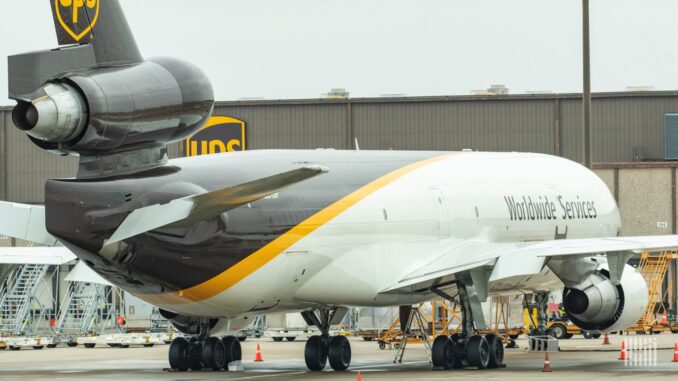
In a sweeping safety measure, the U.S. Federal Aviation Administration (FAA) has ordered the immediate grounding of all McDonnell Douglas MD-11 and MD-11F freighter aircraft, following a fatal cargo-plane crash in Kentucky earlier this month. The emergency directive requires operators to carry out detailed inspections before any further flights are permitted.
What Happened
On 4 November 2025, a UPS-operated MD-11 freighter crashed shortly after take-off from Louisville, Kentucky, killing 14 people. During the aircraft’s initial climb, its left-hand engine and pylon detached from the wing. Investigators believe the separation may point to a potential structural issue affecting other aircraft of the same type.
In response, the FAA issued an Emergency Airworthiness Directive (AD 2025-23-51), citing the risk of “loss of continued safe flight and landing” and describing the problem as a condition likely to exist in other MD-11s. The directive bypasses the normal consultation process due to the immediate safety concerns.
Scope of the Directive
The order applies to all MD-11 and MD-11F aircraft, regardless of operator or configuration. It prohibits flight until the required inspections and any necessary repairs are completed.
Inspections will focus primarily on the engine-to-pylon attachment points, the pylon-to-wing structure, and related systems such as wiring harnesses and thrust-reverser interfaces. Any defects must be rectified in line with FAA-approved procedures before an aircraft can return to service.
Industry Impact
Although the MD-11 has long been retired from passenger service, it remains a cornerstone of the global cargo industry. Major freight operators, including UPS and FedEx, voluntarily grounded their MD-11 fleets in the wake of the incident.
The sudden grounding is expected to cause significant disruption across international air-freight networks, particularly for overnight express operations and transatlantic cargo routes. Logistics firms may face delays and rerouting challenges as they substitute other aircraft types.
Implications for the UK and Europe
While the FAA directive applies to aircraft registered in the United States, European regulators – including the UK Civil Aviation Authority (CAA) and the European Union Aviation Safety Agency (EASA) – are expected to issue parallel actions or safety bulletins.
Operators and maintenance organisations in Europe that handle MD-11s will need to ensure compliance with equivalent safety requirements once these are published. The directive’s implications could also be felt by European freight companies relying on MD-11 capacity through global partners.
What Happens Next
Investigators from the National Transportation Safety Board (NTSB), in cooperation with Boeing and Pratt & Whitney, are analysing the wreckage to determine the root cause of the engine separation. Early findings will shape any follow-up directives or required design modifications.
The FAA has instructed operators to report inspection findings, which could lead to additional mandatory checks or service bulletins. Depending on the investigation’s outcome, the agency may impose long-term restrictions or structural reinforcements to prevent future incidents.
Why It Matters
Engine or pylon separation is among the most severe structural failures an aircraft can experience. While the MD-11 is a proven long-haul workhorse, its age – most examples are more than 25 years old – means fatigue and wear are persistent concerns.
The grounding underscores the FAA’s zero-tolerance approach to safety risks and highlights the continuing importance of rigorous maintenance oversight for older aircraft still vital to the world’s cargo operations.
For aviation professionals, the directive serves as a stark reminder that even legacy aircraft require the same level of scrutiny and safety assurance as the latest generation of jets.
Discover more from UK Aviation News
Subscribe to get the latest posts sent to your email.